A biodegradable urn is built to give back. Instead of holding ashes indefinitely, it is made from materials that break down naturally over time, returning the remains gently to the earth or the water. For families who feel a deep connection to the natural world, or who want a farewell that leaves the lightest possible trace, this type of urn offers something that a metal or ceramic vessel cannot.
What makes an urn biodegradable?
The term covers a wide range of materials. What they share is that none of them will persist in the environment for decades. Common materials include:
- Recycled paper and papier-mache: Lightweight, affordable, and widely available. These dissolve quickly in water and break down in soil within weeks.
- Plant fiber and starch: Often made from cornstarch, rice husks, or other agricultural byproducts. Sturdy enough to display before a ceremony, and fully compostable afterward.
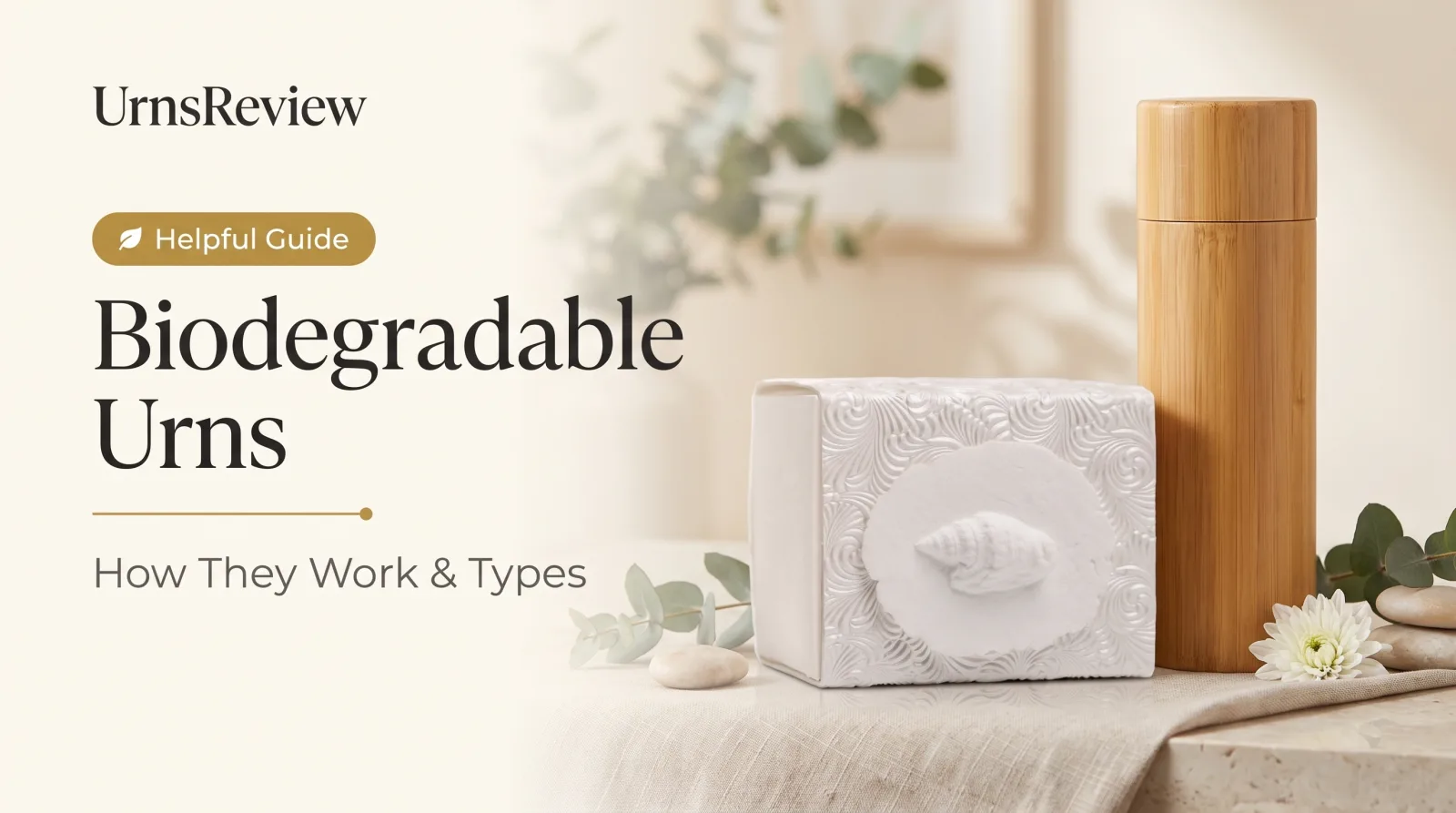
- Bamboo: A fast-growing grass that needs no pesticides. Bamboo urns are stronger than paper and break down more slowly in soil, often over several months.
- Sand and shell: Mixed with a natural binder, these sink smoothly and dissolve in saltwater or fresh water without leaving visible debris.
- Salt: Dense and heavy, salt urns sink quickly and dissolve fully in water. They are among the most popular choices for sea ceremonies.
- Peat and cellulose: Common in tree urns and green burial containers. They integrate readily with soil organisms.
- Clay: Some air-dried clay urns are water-soluble. Fired or glazed ceramics are not biodegradable, so check the product description carefully before buying.
The main types and how each works
| Type | Typical materials | Best use | Breakdown time |
|---|---|---|---|
| Water urn | Salt, sand, shell, paper pulp | Sea, lake, or river ceremony | Minutes to a few hours |
| Earth urn | Paper, plant fiber, bamboo, peat | Burial in garden or green cemetery | Weeks to several months |
| Tree urn | Plant fiber or peat with seed/sapling | Living memorial, planted burial | Months (urn); tree grows for decades |
| Sand and shell urn | Compacted sand, shell fragments | Sea or freshwater scattering | Hours in water |
| Paper or pulp urn | Recycled paper, papier-mache | Earth burial or water release | Days to weeks |
Water urns
A water urn is designed to float briefly on the surface while the family watches, then sink and dissolve as it takes on water. The process is quiet and complete. Some families prefer salt or sand urns because they are denser and sink faster, which suits a more private ceremony at the rail of a boat. Paper urns float a little longer, giving time for a moment of reflection before the vessel disappears.
Sea and river scattering has its own appeal, but it does come with legal requirements. See the section on legal rules below before you plan a water ceremony.
Earth and tree urns
These are buried directly in the ground. A plain earth urn simply contains the ashes and breaks down over time, enriching the soil the way any organic matter does. A tree urn goes a step further: it typically includes a seed or a space for a small sapling, so a tree grows as a living memorial above the burial spot. Families often plant the tree at a meaningful location, a back garden, a woodland, or a green burial ground, and then return to it on anniversaries.
The tree urn concept has grown steadily in popularity as green burial has become more mainstream in North America and the United Kingdom. Green burial grounds now operate in most U.S. states, and many accept cremated remains alongside whole-body natural burials.
Sand and salt urns
These are almost always intended for water ceremonies. Salt urns are particularly popular because salt is inert, dissolves completely, and leaves no trace. They often look like polished stone or carved ceramics and are beautiful enough to use in a home service before the scattering day.
Paper and pulp urns
At the more affordable end of the range, paper urns are a practical choice for families who want an eco-conscious option without a large outlay. They are not as sturdy as bamboo or salt, and they are not intended to be displayed for long periods, but they do exactly what they promise: they break down cleanly and completely.
How to choose the right biodegradable urn
Start with the ceremony you have in mind.
For a water ceremony: Choose a water urn, a salt urn, or a sand-and-shell urn. Confirm it is rated for the body of water you plan to use (open ocean, a lake, or a river). Salt urns are a reliable choice for most water settings.
For a planted memorial or green burial: Choose a tree urn or a plant-fiber earth urn. If you plan to use a natural burial ground, confirm with that cemetery that the specific urn meets their standards before purchasing.
For a garden burial on private land: Check local ordinances first. Many jurisdictions allow burial of cremated remains on private property, but rules vary by county and state. A call to your local health department takes about five minutes and removes any uncertainty.
For a home ceremony followed by scattering later: A sand or salt urn can sit on a shelf looking like a decorative object for weeks or months, then be used for the water ceremony when the family is ready.
Once you know the ceremony type, check the capacity. Most adults still need around 200 cubic inches, and some biodegradable urns marketed as full-size adult urns run a little smaller than that. Read the listed interior volume carefully. Our urn sizing guide walks through the math if you are not sure how much space you need.
If cost is a concern: paper and pulp urns start at around $30. Salt and bamboo urns typically range from $60 to $150. Handcrafted options made from natural shell or carved wood-and-peat composites can run higher.
Legal rules for sea scattering in the United States
If you are planning a water ceremony in U.S. waters, two federal requirements apply.
Under the Marine Protection, Research, and Sanctuaries Act (MPRSA), cremated remains may be scattered at sea, but the release must happen at least 3 nautical miles from shore. This rule is enforced by the U.S. Environmental Protection Agency.
The EPA also requires that the family or whoever performs the scattering notify the EPA within 30 days of the release. The notification is straightforward: the EPA provides a form, and there is no fee. You can find the current form at epa.gov by searching for "burial at sea."
No flowers, plastic, or non-biodegradable materials may be placed in the water at the same time.
State rules can add further requirements, such as additional setback distances or permits for specific waterways. Always check with your state's environmental agency for the waters you plan to use. Rivers and lakes may be governed by different rules than the open ocean.
For rivers or lakes on or near private land, a call to the landowner and local authorities is the right first step.
Green burial: what it means and why families choose it
Green burial, also called natural burial, means interring a body or cremated remains in a way that allows natural decomposition without embalming chemicals, metal hardware, or concrete vaults. For cremated remains, this usually means a biodegradable urn buried directly in the soil at a depth and location that the burial ground specifies.
The Green Burial Council, a nonprofit organization, accredits burial grounds across the United States that meet defined environmental standards. There are now well over 100 such grounds in the U.S. If you want a planted memorial in a dedicated natural cemetery rather than a private garden, the Green Burial Council's website lists certified locations by state.
Sizing: do the same rules apply?
Yes. The standard sizing formula still holds for biodegradable urns: allow roughly one cubic inch of interior volume for every pound the person weighed before cremation. The Cremation Association of North America notes that the typical adult leaves between 183 and 213 cubic inches of cremated remains, so a 200 to 220 cubic inch urn covers most adults comfortably.
One wrinkle: because some biodegradable urns are made by smaller artisan producers, listed dimensions are not always as precise as those from large urn manufacturers. If the product listing does not state interior cubic inches clearly, ask the seller or check reviews for confirmation. Our full sizing guide includes a simple weight-based chart.
Can you keep a small portion separately?
Yes, and many families do. There is no U.S. law against dividing cremated remains. A common choice is to place the majority of the ashes in a biodegradable urn for the ceremony, and keep a smaller portion at home in a keepsake urn. A keepsake urn holds a tablespoon to a cup of ashes and can be a simple, lasting connection for a family member who was not able to attend the ceremony or who simply wants something to keep close.
What biodegradable urns cannot do
A biodegradable urn is not meant to last. That is the point. It is the right choice when the plan is a water release, a burial, or a planted memorial. It is not the right choice if the family wants to keep the ashes at home indefinitely, display the urn on a mantel, travel with it, or protect the remains long-term.
For a permanent home display, a solid metal or ceramic urn is more suitable. For a comparison of those materials, see our wood vs metal vs ceramic guide. For a broader look at all the choices families make with cremated remains, our what to do with cremated ashes guide covers scattering, burial, keepsakes, and more.
Where UrnsReview stands on biodegradable urns
UrnsReview is an independent, reader-supported guide to cremation urns and memorial choices. We review and compare urns across all categories, from solid aluminium keepsakes to eco-friendly burial vessels. We do not manufacture or sell urns, and our editorial choices are not influenced by what earns us a commission. For biodegradable urns specifically, we do not carry any products in our own store, because the two urns we sell are solid aluminium, which is not a biodegradable material. Listing them as eco urns would be misleading, and we are not going to do that.
You can browse a wide selection of biodegradable urns, including water urns, tree urns, salt urns, and bamboo urns, on Amazon. Read the product descriptions carefully, confirm the interior volume, and check that the material matches your planned ceremony.
Frequently asked questions
How long does a biodegradable urn take to break down? Water urns typically dissolve within minutes to a few hours once placed on the surface. Earth and tree urns buried in soil take weeks to several months, depending on the material, soil moisture, and depth. Salt urns break down faster in water than paper or bamboo urns do in soil.
Are biodegradable urns legal for sea scattering in the United States? Yes, with conditions. Under the Marine Protection, Research, and Sanctuaries Act, cremated remains must be scattered at least 3 nautical miles from shore. The family must also notify the U.S. Environmental Protection Agency within 30 days of the scattering. State rules may add further requirements, so check with your state environmental agency as well.
What size biodegradable urn do I need for an adult? The same rule applies as for any urn: roughly one cubic inch of capacity for every pound the person weighed before cremation. Most adults need 200 to 220 cubic inches. Check the listed interior volume before buying, because some biodegradable urns marketed as adult-size run smaller than expected.
Can I keep a portion of ashes in a separate urn and scatter the rest? Yes. There is no U.S. law against dividing cremated remains. Many families place most of the ashes in a biodegradable urn for the ceremony and keep a small portion in a keepsake urn at home. Our keepsake urns guide explains exactly how this works.
Do biodegradable urns work for green burial in a natural burial ground? Most do. Natural burial grounds require that the urn or container break down fully in soil without releasing toxins. Paper, plant-fiber, bamboo, and peat urns generally meet those standards, but practices vary by cemetery. Always confirm with the specific burial ground before purchasing.
What is a tree urn? A tree urn is buried in the ground with cremated remains and typically includes a seed or a compartment for a young sapling. As the urn breaks down, the ashes and decomposing material enrich the surrounding soil and support the tree's growth. The result is a living memorial the family can return to for decades.
Where can I buy biodegradable urns? Biodegradable urns are not something we sell at UrnsReview. You can browse a wide range of water urns, earth urns, tree urns, and salt urns on Amazon. Prices vary widely, typically from about $30 for a simple paper urn to over $150 for a handcrafted salt or bamboo model.