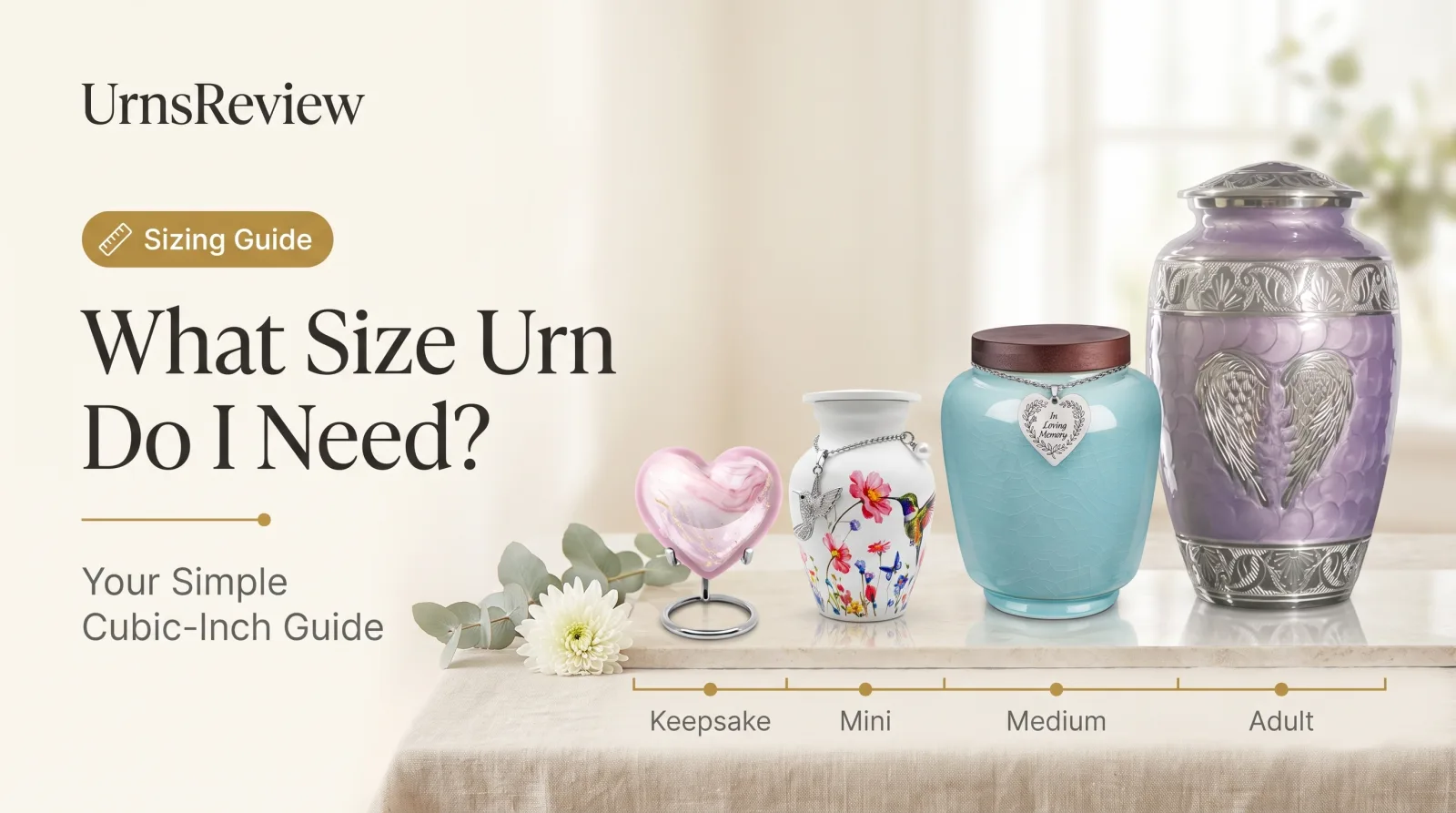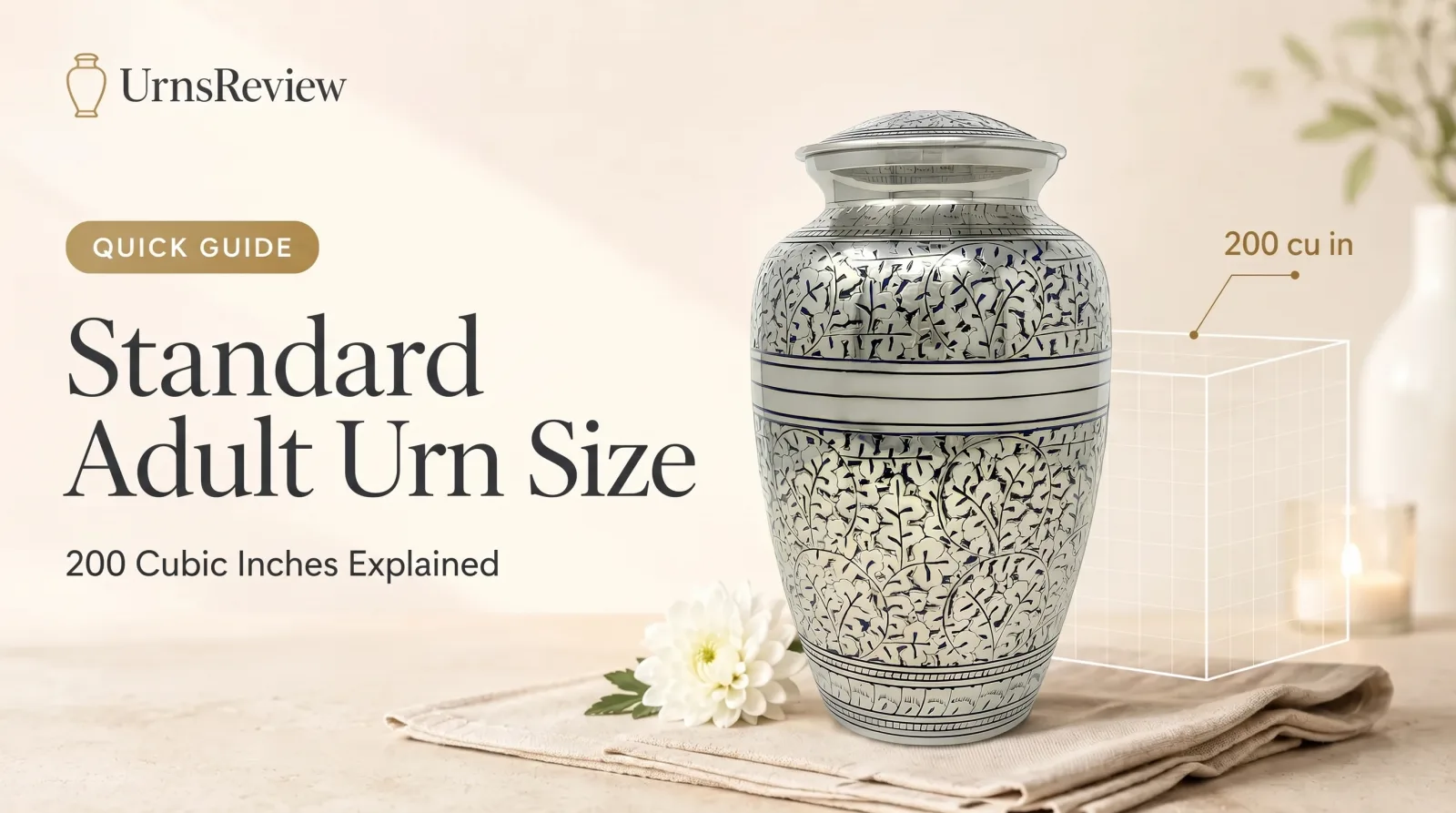
A standard adult cremation urn holds about 200 cubic inches. That number comes from the most widely used guideline in the funeral industry: 1 pound of healthy body weight before cremation equals roughly 1 cubic inch of cremated remains. An adult who weighed 175 lb needs an urn with at least 175 cubic inches of interior capacity; a 200-lb adult needs at least 200.
Why does 200 cubic inches matter?
The 200-cubic-inch figure is not arbitrary. The Cremation Association of North America (CANA) reports that a typical adult leaves approximately 183 to 213 cubic inches of cremated remains. A 200-cubic-inch urn lands near the middle of that range, which is why manufacturers, funeral homes, and family guides have converged on it as the default adult size.
The 1 lb to 1 cubic inch rule holds because ash volume is driven by bone mass, not overall body weight. Fat and soft tissue burn away completely during cremation; what remains is mostly calcium from bones. Adults of similar stature tend to leave similar amounts of ash even if their live weights differed somewhat. Still, the CANA range (183 to 213 cubic inches) shows real variation, which is why giving yourself a margin matters.
The National Funeral Directors Association (NFDA) reports that the U.S. cremation rate has surpassed 60%, meaning millions of families face this exact question every year. Having a clear, reliable number to work from reduces one source of stress during a difficult time.
How do cubic inches relate to outside size?
Cubic inches measure the interior volume of an urn, not its exterior dimensions. Two urns that look almost identical on a shelf can have meaningfully different capacities depending on wall thickness, lid design, and internal shape. A thick-walled ceramic urn might have 10 to 20 fewer usable cubic inches than a metal urn of the same outside height and width.
Always check the interior capacity listed by the manufacturer, not just the outside measurements. When a listing says "200 cubic inch urn," it should mean the usable space inside.
Weight-to-capacity reference table
Use your loved one's approximate healthy body weight before any illness-related decline. Weight lost late in life does not meaningfully reduce the amount of ash, because ash volume comes from bone, not body mass that changes with illness.
| Body weight before cremation | Minimum urn capacity needed |
|---|---|
| Up to 100 lb | 100 cu in |
| Up to 125 lb | 125 cu in |
| Up to 150 lb | 150 cu in |
| Up to 175 lb | 175 cu in |
| Up to 200 lb | 200 cu in |
| Up to 220 lb | 220 cu in |
| Up to 250 lb | 250 cu in |
| Over 250 lb | 300+ cu in |
If you are unsure of the weight, round up. The cost difference between a 200-cubic-inch and a 220-cubic-inch urn is usually small, and the peace of mind is worth it.
For the full sizing walkthrough, with a more detailed chart and the questions funeral directors ask, see our guide What Size Urn Do I Need?.
Why a 220-cubic-inch urn is the smart default
A 220-cubic-inch urn is one of the most practical sizes on the market. Here is why it became the roomy-but-not-oversized standard for many families:
- It covers the entire CANA statistical range (183 to 213 cubic inches) with 7 to 37 cubic inches to spare.
- It fits adults up to about 220 lb without guesswork.
- It handles cases where the crematory returns slightly more remains than the strict guideline would predict.
- It does not cross into the "oversized" category, so it looks proportional on a mantel or shelf.
The Crimson Red Rose Urn holds exactly 220 cubic inches and is built from solid aluminium with a hand-engraved rose and a threaded screw lid that will not come loose. At $59.99 with a 4.9-star rating, it is the urn UrnsReview recommends as the best starting point for most adults. It also comes in blue and purple if the crimson finish is not the right match.
For a deeper look at how it compares against other adult urns on the market, see our best cremation urns for adults guide.
Size tiers: standard, oversized, companion, and keepsake
Not every family needs a standard 200-cubic-inch urn. Here is how the size tiers break down.
Standard adult (183 to 220 cubic inches) Covers the large majority of adults. A 200-cubic-inch urn fits the statistical center; a 220-cubic-inch urn gives a practical margin. This is the right tier for most people reading this article.
Oversized (250 to 325+ cubic inches) For adults who weighed over about 220 to 225 lb, an oversized urn ensures everything fits without worry. Some families also choose this tier simply because extra certainty matters to them. There is no aesthetic penalty; oversized urns are made in the same styles and materials as standard adult urns.
Companion (around 400 cubic inches) A companion urn is designed to hold the ashes of two people together, most often a couple. Two full adult portions (roughly 200 cubic inches each) need at least 400 cubic inches of combined capacity. Companion urns are physically larger than standard urns; plan for that if you want to display one on a shelf or in a niche.
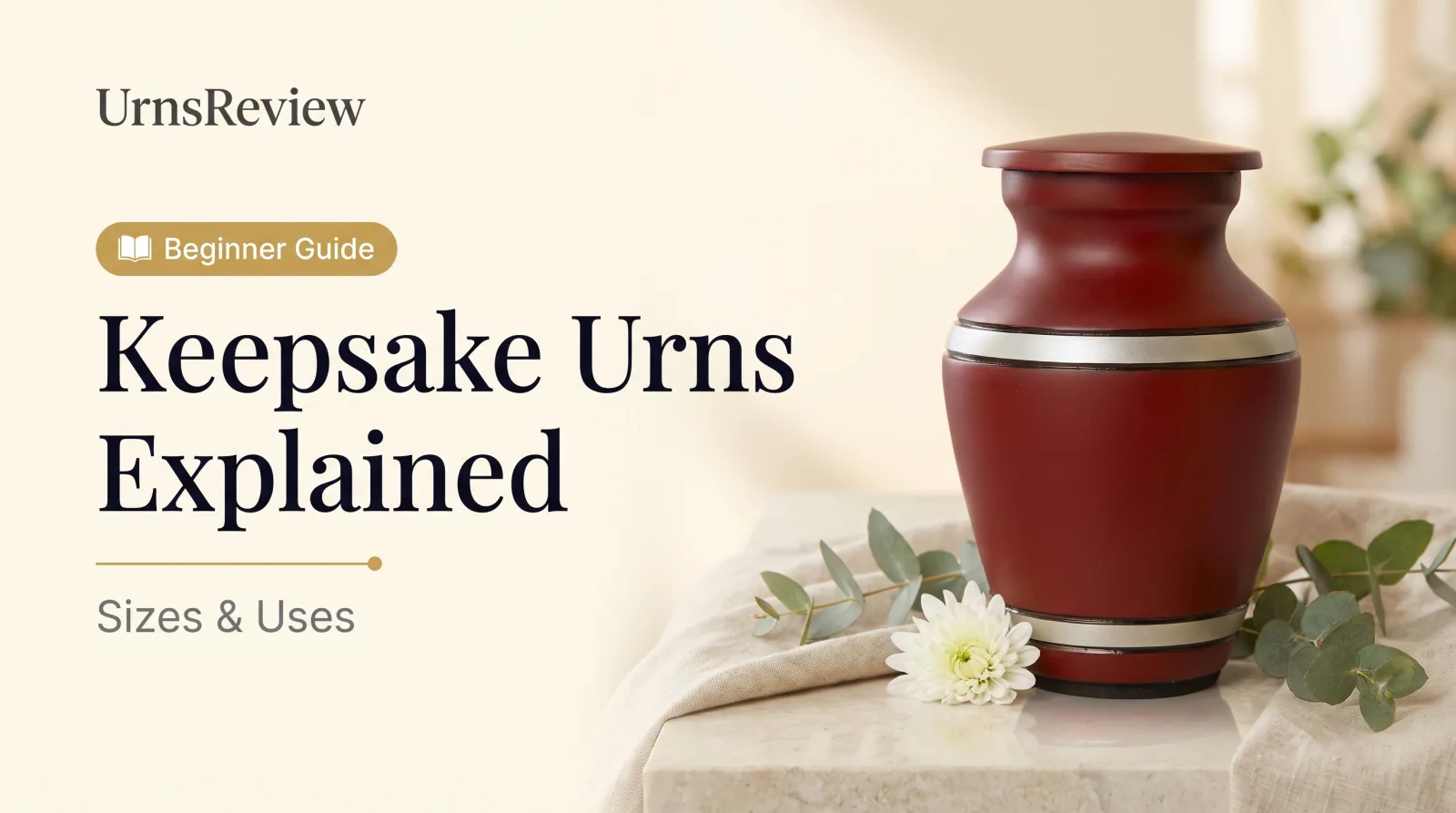
Keepsake (1 to 50 cubic inches) Keepsake urns hold a small portion of ashes so that multiple family members can each keep something close. They are used alongside a full-sized urn, not as a replacement. The Crimson Small Keepsake Urn is a compact companion to the Rose Urn; check the listing for current capacity and price. For more on how families use them, see Keepsake Urns Explained.
For all size categories in one place, the Urn Sizing hub gathers every guide and chart.
Interior cubic inches vs. exterior dimensions: a common confusion
Urn listings sometimes include exterior dimensions in inches (height x width x depth) alongside the cubic-inch capacity. These are not the same thing, and conflating them causes real problems.
- Exterior dimensions tell you how much space the urn takes up on a shelf or in a niche.
- Interior cubic inches tell you how much ash the urn can actually hold.
A columbarium niche, for example, has a set exterior opening. If you are buying an urn for a niche, you need to check the outside dimensions fit the niche opening, AND that the interior capacity fits the amount of ash you have. Both checks are necessary.
When a number is listed as "X cubic inches" in a product title or specification table, it nearly always refers to interior capacity. If you see only external dimensions listed (like "10 x 6 x 4 inches"), calculate the rough exterior volume and remember the interior will be smaller due to walls. When the capacity is unclear, ask the seller before purchasing.
Materials and how they affect capacity
The material of an urn changes how much of its physical size translates into interior space.
| Material | Typical wall thickness | Effect on interior capacity |
|---|---|---|
| Aluminium | Thin (2 to 4 mm) | Most interior space relative to outside size |
| Brass | Moderate (3 to 5 mm) | Slightly less interior space; heavier overall |
| Ceramic | Thicker (6 to 10 mm+) | Noticeably less interior space per outside size |
| Solid wood | Thicker (10 to 20 mm) | Least interior space per outside size |
This is one reason metal urns often offer a better capacity-to-footprint ratio than ceramic or wood urns of similar external dimensions. Our wood vs. metal vs. ceramic guide covers the other trade-offs, including durability, feel, and where each material works best.
When to size up without hesitation
Funeral directors give consistent advice on this: when in doubt, go slightly larger. There is no downside to extra space inside an urn. The situations where sizing up is clearly the right call:
- The weight is uncertain or was not recorded precisely.
- The person was at or near the top of a weight tier (say, 195 lb with a 200-cubic-inch urn in mind).
- The family wants complete peace of mind and the cost difference is minimal.
- The urn will be used for burial, where reopening it later to transfer ashes would be difficult.
An urn can be too small. It can never be too large. That asymmetry makes the choice straightforward when you are between two sizes.
About UrnsReview
UrnsReview is an independent, reader-supported guide to cremation urns and memorial choices. We are not a funeral home and do not manufacture urns, so we have no incentive to push a specific product or price point. Every guide is checked against industry sources including CANA and the NFDA, and we update content when products change. If you find this guide useful, the linked articles below go deeper on each topic.
Frequently asked questions
How many cubic inches is an adult urn? A standard adult urn holds about 200 cubic inches. The Cremation Association of North America (CANA) puts the typical adult range at 183 to 213 cubic inches. The widely used guideline is 1 pound of healthy body weight before cremation equals roughly 1 cubic inch of cremated remains.
What does '200 cubic inches' mean on an urn listing? It is the interior volume of the urn, not the outside dimensions. Two urns that look the same on a shelf can have very different interior capacities depending on wall thickness and lid design. A 200-cubic-inch urn can hold the ashes of an adult who weighed up to about 200 pounds.
Is a 220-cubic-inch urn big enough for most adults? Yes. A 220-cubic-inch urn covers the full CANA statistical range (183 to 213 cubic inches) with room to spare, and fits adults up to about 220 pounds. It is one of the most practical sizes available because it handles nearly all adults without stepping into an oversized model.
What is the 1 pound equals 1 cubic inch rule? It is the standard guideline from the funeral industry: for every pound a person weighed before cremation, expect about 1 cubic inch of cremated remains. The ash volume comes mainly from bone mass, so the rule holds across a wide range of body types, though individual results can vary slightly.
How big is a companion urn? A companion urn is designed to hold the ashes of two people, typically a couple. Most companion urns hold around 400 cubic inches so both full adult portions fit comfortably. They are usually larger in external size than a standard urn.
What size is a keepsake urn? Keepsake urns are small, typically holding 1 to 50 cubic inches. They are meant to hold a small portion of ashes so multiple family members can each keep something close. They are used alongside a full-sized urn, not as a replacement for one.
Can an urn be too large? No. An urn can be too small, but it can never be too large. Ashes do not expand, and they do not need to fill the container. Choosing a slightly bigger urn simply means there is empty space at the top, which is perfectly fine and is often the recommended approach.