A keepsake urn is a small urn made to hold a portion of cremated ashes, not a complete set. Where a standard adult urn holds 200 or more cubic inches, a keepsake typically holds just 1 to 5 cubic inches: enough for a meaningful amount, not the whole. They go by several names: mini urns, sharing urns, companion keepsakes. The idea behind all of them is the same. When more than one person grieves, more than one person can keep something close.
UrnsReview is an independent, reader-supported guide to cremation urns. We do not make or sell urns, which means the only thing we are trying to do here is give you clear information.
What exactly is a keepsake urn?
A keepsake urn is any urn designed to hold a partial amount of ashes. The key features that distinguish it from a standard urn:
- Capacity: 1 to 5 cubic inches, compared to 200-plus for an adult urn
- Purpose: to carry a portion, not the full remains
- Use case: sharing among family, travel, keeping a small amount after scattering or burial
- Also called: mini urns, small urns for ashes, sharing urns, companion urns
They are not a modern invention. Families have kept small portions of ashes in lockets, vials, and miniature containers for well over a century. The contemporary keepsake urn is simply a more formal, better-sealed version of the same idea.
Why families choose keepsake urns
Grief rarely belongs to just one person. When a parent, spouse, or sibling dies, several people may feel an equal pull to keep something tangible. A keepsake urn makes that possible without asking anyone to give up "the urn."
The most common reasons:
- Sharing among relatives. Siblings in different cities, adult children who live far apart, a grandparent surviving in another state. Each person gets a small urn of their own.
- Keeping some after scattering. Families who scatter ashes at sea, in the mountains, or at a meaningful place often want to hold back a small amount at home.
- Keeping a portion after burial or inurnment. If the main urn goes into a columbarium niche or a grave, a keepsake lets family members still have something personal at home.
- Travel and distance. A 1 to 3 cubic inch urn fits in a bag, a bedside drawer, or a carry-on. For a relative who cannot display a full urn, a keepsake is the right scale.
For a fuller look at the options families consider after cremation, see our guide to what to do with cremated ashes.
How large is a keepsake urn? Size tiers explained
Standard adult urns hold roughly 200 cubic inches, based on the common guideline of one cubic inch per pound of body weight before cremation. Keepsake urns sit at the opposite end of that scale.
| Tier | Capacity | What it looks like | Good for |
|---|---|---|---|
| Token | 1 to 2 cu in | Roughly thimble to golf-ball sized | One distant relative, a small symbolic amount |
| Standard keepsake | 3 to 5 cu in | A few inches tall, miniature vase or cylinder | One family member keeping a real portion |
| Large keepsake | 6 to 10 cu in | Noticeably larger, still not a main urn | Closer relatives wanting a more substantial share |
Most products sold as keepsake urns fall in the 1 to 5 cubic inch range. If a listing does not state the capacity clearly, that is worth checking before you order. Capacity is listed in cubic inches, and the number matters. A "small urn" with no stated capacity is not a useful product description.
For the math on full-size urns, including how to calculate exactly what your loved one will need, see what size urn do I need.
Is it legal to divide ashes?
Yes. There is no U.S. federal law against dividing cremated remains. The Cremation Association of North America (CANA) is clear that families may distribute ashes as they see fit. Some states and localities have rules about where you may scatter ashes outdoors, but splitting ashes into multiple containers is not prohibited anywhere in the United States.
If you are planning to carry ashes on a flight, the TSA allows cremated remains in carry-on bags in a container that can pass through X-ray screening. Metal containers sometimes require additional inspection, so check with your airline before flying with a keepsake.
How to divide ashes respectfully: a step-by-step
Dividing cremated remains is more common than most people realize, and doing it yourself at home is straightforward. The process is gentle and takes only a few minutes.
- Prepare a clean, flat surface. A kitchen table covered with a large sheet of white paper works well. The white background makes it easy to see any ashes that spill so nothing is lost.
- Use a clean, dry scoop. A small kitchen spoon or a dedicated craft scoop is fine. If you are filling multiple containers, rinse and fully dry the scoop between each one to avoid mixing moisture.
- Fill the keepsake urns first. It is easier to transfer a small amount into a small opening while the main supply is still accessible. Seal each keepsake as you finish it before moving to the next.
- Transfer the remainder into the main urn. Use a small funnel if the opening is narrow. Cremated remains can also be kept in the bag or container the crematory provides and lowered directly into the main urn.
- Seal every container securely. Threaded lids should be hand-tightened. If the keepsake uses a friction or cork-style lid, confirm it is fully seated before putting the urn away.
- Label each container if you are distributing several. A small adhesive label on the base keeps things clear, especially if the keepsakes are identical.
There is no rush. Many families find it helpful to do this with one other trusted person present. Some choose to say a few words or sit quietly for a moment before they begin.
Keepsake urns and main urns: how they work together
A keepsake urn is a companion piece, not a replacement for a main urn. In a typical setup, the full-size urn holds the majority of the ashes for display at home, placement in a columbarium, or eventual scattering. The keepsakes hold the small portions that go to individual family members.
| Item | Capacity | Role |
|---|---|---|
| Main urn (e.g., Crimson Red Rose Urn) | 220 cu in | Holds the full set of ashes for primary display or burial |
| Standard keepsake urn | 1 to 5 cu in | Holds a share for one family member |
| Second or third keepsake | 1 to 5 cu in | Same, for another relative |
Buying the keepsakes at the same time as the main urn helps, because the ashes can be divided once rather than transferred again later.
The Crimson Small Keepsake Urn
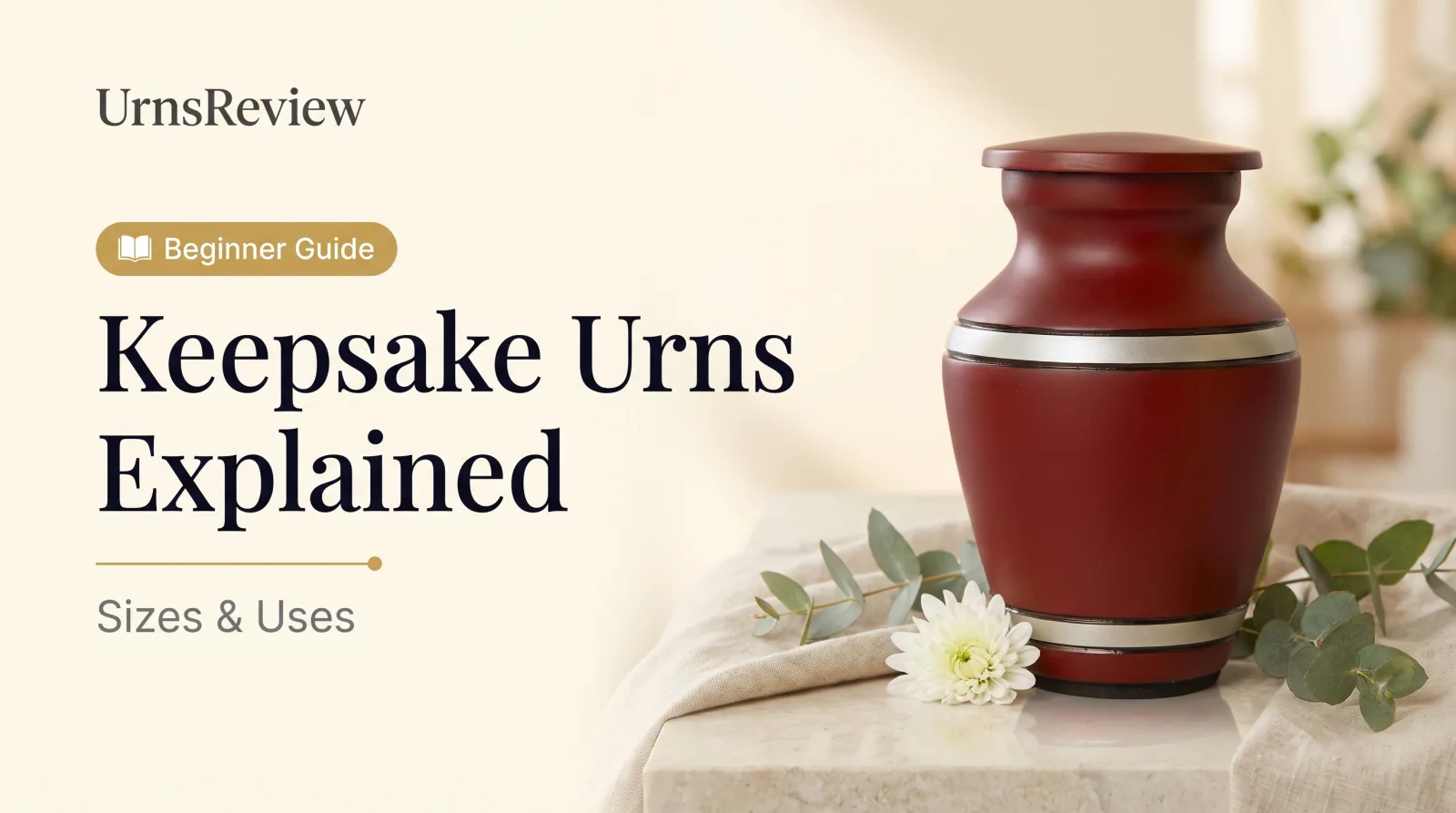
The Crimson Small Keepsake Urn is a compact, well-finished keepsake that pairs with the Rose Urn family. Its deep crimson finish matches the full-size Crimson Red Rose Urn, so a set displayed together looks intentional rather than mismatched.
A few things to know before ordering: the exact price and cubic-inch capacity are not confirmed in our data. Check the current listing on Amazon for both numbers before you buy, especially if capacity is important for your situation. What is clear from the design is that it is built for keepsake use: small, finished in a matching crimson, and meant to hold a meaningful portion alongside a full-size urn.
The matching main urn: Crimson Red Rose Urn
If you are buying the keepsake as part of a set, the Crimson Red Rose Urn is the natural companion. Quick facts:
- Capacity: 220 cubic inches (fits most adults up to about 220 lb)
- Material: Solid aluminium, light and rust-proof
- Lid: Threaded screw closure
- Design: Hand-engraved rose in matte crimson with silver banding
- Price: $59.99
- Rating: 4.9 stars
- Also available in: Blue and purple
The engraving is etched into the metal, not printed, so it will not fade or peel. This is the urn we cover in more depth in our guide to the best cremation urns for adults, and it is the piece families most often pair with a keepsake from the same line.
For families buying for a mother or grandmother specifically, the rose design often feels particularly fitting. See our best urns for mom guide for more on that.
What to look for when buying a keepsake urn
Not every small urn is made to the same standard. A few things worth confirming before you order:
- A secure lid. A threaded closure or a snug-fitting cap is the right choice. A loosely placed cover is not suitable for something you plan to keep for decades or pass to a relative.
- Durable material. Brass and aluminium are the most resilient. Ceramic works well for indoor display. Thin plastic is not a good choice for a permanent keepsake.
- Stated capacity. The listing should tell you the cubic-inch capacity. If it does not, that is a gap worth closing before you buy.
- A design that feels right. Keepsake urns are often kept in view: on a mantel, a nightstand, a bookshelf. Choose something that reflects the person you lost or the taste of the person receiving it.
- Compatibility with the main urn. If you want a matched set, confirm the finish and style before ordering both.
Buying multiple keepsakes
There is no rule that limits a family to one keepsake urn. Many families order two or three so each person who wants one can have their own. If you are coordinating across several relatives, it helps to settle on a number before the cremation so you can divide the ashes once. Transferring ashes multiple times is not harmful, but it is easier to get it right the first time.
If you are planning a larger shared memorial, our ashes memorialization hub brings together the full range of options families consider, from keepsakes to scattering to permanent display.
How keepsake urns fit into the bigger picture
Choosing what to do with a loved one's ashes is one of the more personal decisions a family makes. There is no single right answer. Some families prefer everything in one place. Others feel strongly that each person who grieves should have something physical to hold. Keepsake urns are one of the quieter solutions: a small, well-made container that lets grief be shared rather than held by one person alone.
If you are still working through the broader question of what to do with cremated ashes, our overview at what to do with cremated ashes covers all the main paths families take, including scattering, burial, memorial jewelry, and permanent display.
Frequently asked questions
What is a keepsake urn? A keepsake urn is a small urn made to hold a portion of cremated ashes rather than a full set. Most hold between 1 and 5 cubic inches. They are also called mini urns or sharing urns. Families use them so more than one person can keep a piece of their loved one close.
How much do keepsake urns hold? Most keepsake urns hold between 1 and 5 cubic inches of ashes. A 1 to 2 cubic inch keepsake holds a small token amount, while a 3 to 5 cubic inch keepsake carries a more noticeable portion. Both are far smaller than a standard adult urn, which typically holds 200 or more cubic inches.
Is it legal to divide ashes among family members? Yes. There is no U.S. federal law against dividing cremated remains. The Cremation Association of North America notes that families may distribute ashes as they choose. Some states have rules about scattering in specific locations, but splitting ashes into separate containers is not restricted.
Do keepsake urns need to be airtight? A fully airtight seal is not required, but a secure lid is. Look for a threaded closure or a snug-fitting cap that will not work loose over time. A loosely placed cover is not suitable for a piece you plan to keep for years or pass along to a relative.
Can I buy multiple keepsake urns at once? Yes, and many families do. If three siblings each want a portion, order three keepsakes before the cremation so you can divide the ashes once rather than transferring them multiple times. It also helps to agree on the plan in advance so everyone is comfortable with the process.
Do I still need a main urn if I buy keepsake urns? In most cases, yes. Keepsake urns hold a small portion only. The rest of the ashes still need a full-size urn for display, burial, or a columbarium. A common approach is one main urn for the majority of ashes plus one keepsake per family member who wants their own.
What material is best for a keepsake urn? Brass and aluminium are the most durable options and will not rust, crack, or tarnish over decades. Ceramic is a good choice for indoor display. Avoid thin plastic or resin for a permanent keepsake. A threaded or snug lid is more important than the material itself for long-term security.